Solar Panels and CO2 Savings in 2026: Real Numbers for Your Home
Solar Panels and CO2 Savings in 2026: Real Numbers for Your Home
How much CO2 does a solar panel system actually save?
The short answer: A typical UK home solar system of 6 kWp saves roughly 1.2 tonnes of CO2 per year compared to the average grid mix. Over the system's 30-year lifespan, that adds up to 36 tonnes of CO2 — equivalent to about 120 return flights from London to Barcelona.
But the numbers depend on several factors: How large is your roof? What's your current electricity consumption? And what kind of power are you replacing? Let's dive into the calculations.
How to calculate your CO2 savings — step by step
1. Your energy use and system size
The more of your own solar power you use, the greater the climate benefit. A standard 4-8 kWp system covers between 30% and 70% of an average household's electricity needs.
Rule of thumb: Every kWh of solar power you use instead of grid electricity saves about 0.23 kg CO2 (based on the UK grid average of 230 g CO2/kWh as of 2026, per DESNZ figures).
2. Self-consumption vs. grid export
The electricity you use directly delivers the biggest CO2 savings. Surplus power sent to the grid has a slightly lower climate benefit, as it displaces other renewables during peak solar hours.
Example: A household with 4,500 kWh annual consumption and a 6 kWp system producing 5,400 kWh can achieve about 40% self-consumption:
- Direct use: 1,800 kWh × 0.23 kg CO2 = 414 kg CO2 saved
- Grid export: 3,600 kWh × 0.12 kg CO2 = 432 kg CO2 saved
- Total saving: Roughly 846 kg CO2 per year
What about batteries? How to double your climate impact
With a 10 kWh home battery, self-consumption can rise to 65-80%. That means more of your green power is used at home — even in the evening when the sun isn't shining.
For the same household with a 6 kWp system and battery:
- Self-consumption rate: Up to 75%
- CO2 savings: Roughly 1,100 kg CO2 per year
- Over 30 years: Nearly 33 tonnes of CO2
That's equivalent to taking five petrol cars off the road for an entire year.
Renters, leaseholders, and flat owners — there are options for you too
You don't need a detached house to contribute to the green transition. Here are your options:
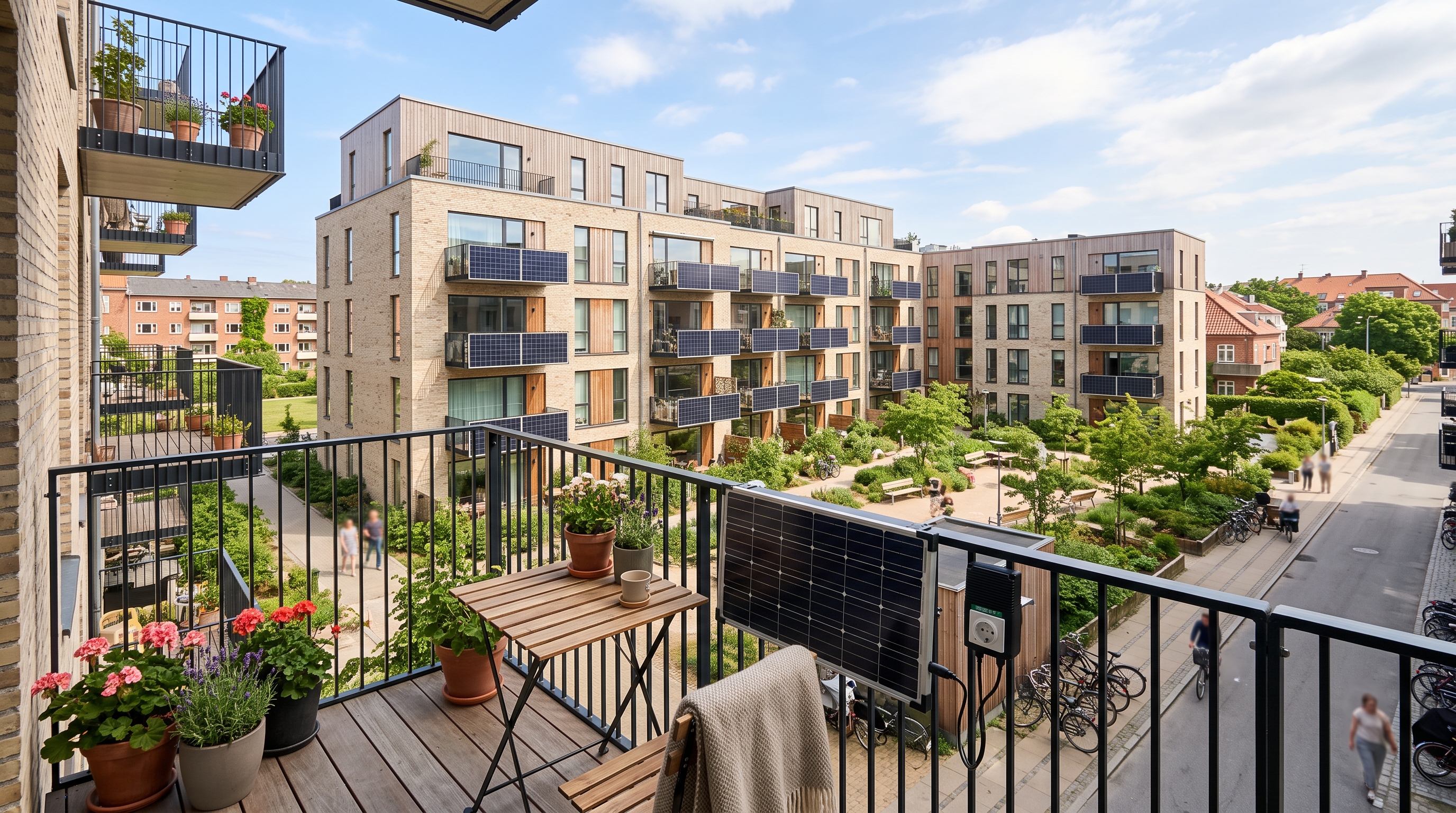
Plug-in balcony solar panels
Small 300-800 watt systems can be mounted on balconies, terraces, or in the garden. They require no planning permission in most cases and can move with you when you relocate. A 600W balcony system saves roughly 65 kg CO2 per year and starts from around £300.
Housing cooperatives and block management
More and more shared-ownership buildings are investing in communal solar installations. The advantage is scale: A 30 kWp system for a block of 20 flats saves roughly 3.9 tonnes of CO2 per year and reduces service charges for everyone.
Green energy tariffs
If you have neither a roof nor a balcony, you can choose a 100% renewable electricity tariff. It's the next best option — and often no more expensive than standard tariffs. Check with your energy supplier about their green products.
Carbon accounting: When do solar panels become carbon-neutral?
Solar panels also have a carbon footprint from manufacturing. The good news: Modern panels have an energy payback time of under 1.5 years in Northern European conditions. That means after a year and a half, the panel has produced more energy than was used to manufacture it.
The full carbon ledger for a 6 kWp system:
- Manufacturing carbon footprint: Roughly 2.5 tonnes CO2 (panels, inverter, mounting, transport)
- Annual savings: 846-1,100 kg CO2
- Carbon-neutral after: 2.5-3 years
- Net CO2 savings over 30 years: 23-30 tonnes CO2
What the experts say
According to the IEA's latest Photovoltaic Power Systems report, solar PV has the lowest lifecycle emissions of any mainstream electricity source at roughly 30-50 g CO2/kWh — compared to 820 g for coal and 490 g for gas. As grids decarbonise, the marginal CO2 savings per kWh decrease, but solar's total climate contribution remains substantial.
UK researchers estimate that residential solar in Britain saves an average of 500-750 g CO2 per installed watt over its lifetime. That makes solar one of the most effective climate technologies available to households.
CO2 savings by property type
| Property Type | System | Annual CO2 Saving | 30-Year Saving |
|---|---|---|---|
| Detached house (6 kWp) | Roof-mounted | 846 kg | 25.4 tonnes |
| Detached with battery | 6 kWp + 10 kWh | 1,100 kg | 33 tonnes |
| Semi-detached (4 kWp) | Roof-mounted | 564 kg | 16.9 tonnes |
| Flat (balcony) | 600W plug-in | 65 kg | 1.95 tonnes |
| Housing coop (per flat) | 30 kWp / 20 units | 195 kg | 5.9 tonnes |
Note: CO2 savings calculated using UK 2026 grid average emission factor of 230 g CO2/kWh. Figures for self-consumed solar use the full emission factor; exported solar is discounted to reflect grid displacement dynamics.
Frequently Asked Questions
How long until solar panels become carbon-neutral?
For a standard 6 kWp system in the UK or Ireland, it takes roughly 2.5-3 years to become fully carbon-neutral, accounting for manufacturing, transport, and installation. After that, all produced electricity is a net benefit for the climate.
Are balcony solar panels worth it?
Yes, if you're a renter or live in a flat. A 600W balcony system starts from around £300, saves roughly £40-60 a year on your electricity bill, and reduces your carbon footprint by 65 kg annually. You can take it with you when you move.
What happens to CO2 savings as the grid gets greener?
As grids decarbonise, the marginal CO2 savings per kWh decrease. However, solar panels still help displace fossil fuel generation during peak demand periods. Home batteries amplify this effect by shifting solar energy into evening hours when grids are often dirtier.
Are there grants for solar panels in 2026?
In the UK, the Smart Export Guarantee (SEG) pays you for electricity you export to the grid, but there are no direct installation grants for residential solar as of 2026. In Ireland, the Micro-generation Support Scheme offers payments for surplus electricity. Contact EcoRay for a personalised calculation for your property.
Start your CO2 savings journey
Solar panels are one of the most tangible ways to reduce your carbon footprint. Whether you own a house, rent a flat, or live in shared ownership, there's a solution that fits.
At EcoRay, we help calculate your potential CO2 savings based on your specific circumstances — roof orientation, consumption patterns, and budget. Book a no-obligation chat and get your personalised figures.