Complete Guide to Commercial Solar Panels in 2026
Why Commercial Solar Makes Sense in 2026
Businesses with annual electricity consumption above 100,000 kWh can achieve significant savings with solar panels — but only if the calculations are grounded in real consumption profiles, current grid tariffs, and local connection conditions. This is where many go wrong: they focus on installation costs and forget to calculate how much of the generated electricity they actually use themselves.
Electricity prices for UK businesses averaged 25-35 p/kWh in 2025, with similar trends in Ireland at 28-38 c/kWh. Projections for 2026 point to stable levels with increasing network charges during peak periods. A business with 150,000 kWh annual consumption and a steady daytime load can typically achieve a self-sufficiency rate of 25-40% with a roof-mounted system of 80-120 kW. This largely depends on whether consumption aligns with solar production hours.
EcoRay is not an installer — we provide impartial calculations based on grid data, local network tariffs, and your actual half-hourly consumption. This means you get a realistic picture of the economics before speaking to installers.
The Three Biggest Benefits
- Reduced electricity bills from day one — but only when production and consumption are time-matched. Electricity exported to the grid typically fetches a lower price than what you save through self-consumption.
- Verifiable carbon reduction — system production data can be used directly in ESG reporting, strengthening your company's green credentials with customers, investors, and employees. This is increasingly important as the UK's Streamlined Energy and Carbon Reporting (SECR) framework and the EU's Corporate Sustainability Reporting Directive (CSRD) tighten requirements.
- Increased property value — a well-documented solar installation with known operational data makes the property more attractive for sale or lease, especially as sustainability requirements for commercial buildings tighten across Europe.
Step-by-Step: How to Get Started
- Gather consumption data — Download half-hourly values from your electricity supplier for at least one full year. This provides the necessary foundation for calculating when you use power and when a solar installation generates it.
- Get an impartial capacity calculation — A calculator that includes 2026 network tariffs, including any new capacity charges from your distribution network operator, gives a realistic picture of actual savings.
- Check grid connection — Contact your local Distribution Network Operator (DNO) to clarify whether there is capacity at the substation. In areas with high solar uptake, there may be constraints or requirements for connection charges. In the UK, use the Energy Networks Association's (ENA) connection portal for guidance.
- Assess the roof's load-bearing capacity — Solar panels add 15-20 kg/m². A structural calculation from a qualified engineer determines whether the roof can bear the load or requires reinforcement.
- Obtain quotes from certified installers — Ensure you get at least three quotes and compare them on price, panel type, inverter quality, and warranty terms. In the UK, look for MCS-certified installers; in Ireland, SEAI-registered contractors.
- Clarify tax treatment — In the UK, commercial solar qualifies for the Annual Investment Allowance (AIA) up to £1 million, allowing full tax relief in the year of purchase. In Ireland, the Accelerated Capital Allowances (ACA) scheme covers energy-efficient equipment. Consult your accountant on how the installation should be treated in your accounts.
- Install and monitor — After installation, set up continuous monitoring via API or app so you can track production and detect faults quickly.
Typical ROI Scenarios for Businesses
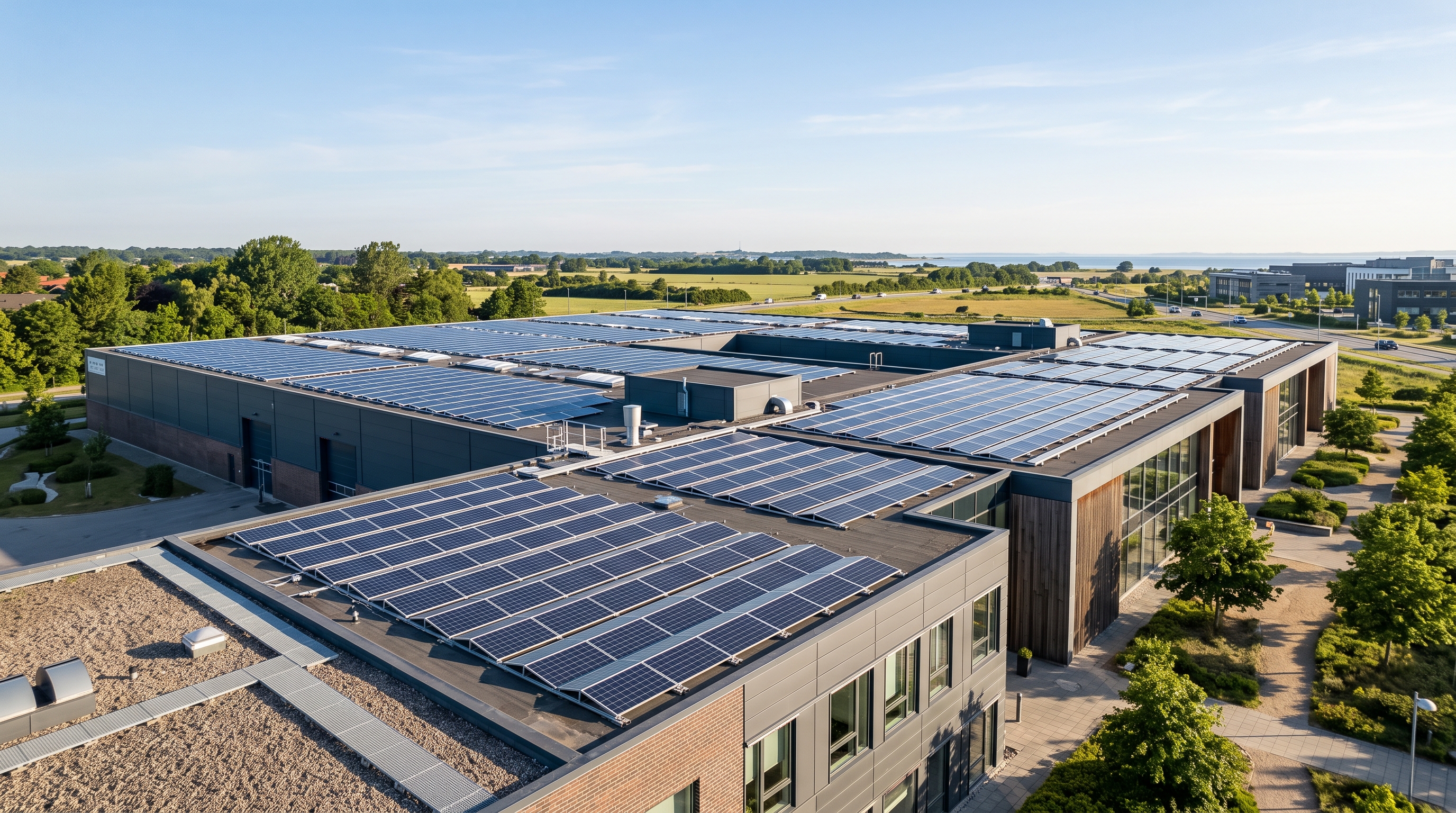
Let's look at a concrete example: A warehouse with 300,000 kWh annual electricity consumption where a 200 kW solar system is installed on the roof.
At an average electricity price of 25 p/kWh (UK) or 30 c/kWh (Ireland) and a self-sufficiency rate of 30% — meaning 30% of the generated electricity is used directly in the business — the system delivers annual savings of £14,000-£19,000 (or €16,000-€22,000) before tax. The payback period typically sits at 6-7 years, after which the marginal cost of self-generated electricity is near zero for the system's remaining lifespan of 20-25 years.
It's important to note: generic investment grants for commercial solar are limited in 2026. Previous schemes have largely been wound down in both the UK and Ireland. However, the tax allowances (AIA in the UK, ACA in Ireland) and the Smart Export Guarantee (SEG) in the UK — or the Clean Export Guarantee (CEG) in Ireland — still improve the business case significantly.
Export Tariffs for Businesses
In the UK, the Smart Export Guarantee (SEG) requires licensed electricity suppliers to offer an export tariff to small-scale low-carbon generators. Rates vary by supplier but typically range from 4-15 p/kWh. In Ireland, the Clean Export Guarantee (CEG) operates similarly, though rates tend to be slightly higher at 14-20 c/kWh for the first tranche. Export revenue alone rarely justifies a solar installation — the real value is in self-consumption, so design your system to maximise on-site usage.
Investment and Financing
A 200 kW solar installation typically costs between £100,000-£160,000 (or €120,000-€180,000) including installation, depending on panel type, roof conditions, and inverter choice.
Several financing options exist:
- Direct purchase — Delivers the best return but ties up capital.
- Green business loans — Several UK and Irish banks offer specialist lending products for energy efficiency with competitive rates. The UK's Carbon Trust and Ireland's Strategic Banking Corporation of Ireland (SBCI) both have energy-efficiency loan schemes worth exploring.
- Leasing — Enables solar panels without a large upfront investment. You pay a fixed monthly fee, and electricity bill savings cover all or part of the cost.
- Power Purchase Agreement (PPA) — A third party owns and operates the system on your roof, and you buy the electricity at a fixed agreed price. Particularly relevant for larger installations where minimising upfront capital is a priority.
Risks and Limitations in 2026
While commercial solar is a sound investment for many businesses, there are factors to be aware of:
- Grid connection may be refused — Network operators can reject or limit connection at overloaded substations. Investigate this early in the process — in the UK, pre-application enquiries to your DNO are free.
- Roof structure must be checked — Not all roofs can bear 15-20 kg/m² additional load without reinforcement. A structural survey is a small expense that can save major problems later.
- Self-sufficiency varies widely — Depending on your consumption profile, self-sufficiency can range from 20-50%. Businesses with significant evening or night consumption benefit less from solar without battery storage.
- Curtailment during negative prices — During periods of high renewable generation, wholesale electricity prices can turn negative. In those cases, it may be better to limit production. Smart inverters can handle this automatically.
- Ongoing maintenance — Solar panels require minimal maintenance, but inverters have an expected lifespan of 10-15 years and replacement should be budgeted for.
Is Solar Right for Your Business?
Commercial solar isn't a quick fix — but for businesses with significant daytime consumption, a suitable roof area, and realistic expectations about the economics, it's one of the most predictable long-term investments in lower operating costs and a greener profile.
At EcoRay, we help you run the numbers, so you know exactly what you're getting into — before you sign with an installer.
This article is a localised version for UK and Irish readers. References to Danish schemes, regulations, and pricing have been replaced with UK/IE equivalents. Electricity pricing is indicative and based on 2025 averages; actual rates vary by supplier and contract.