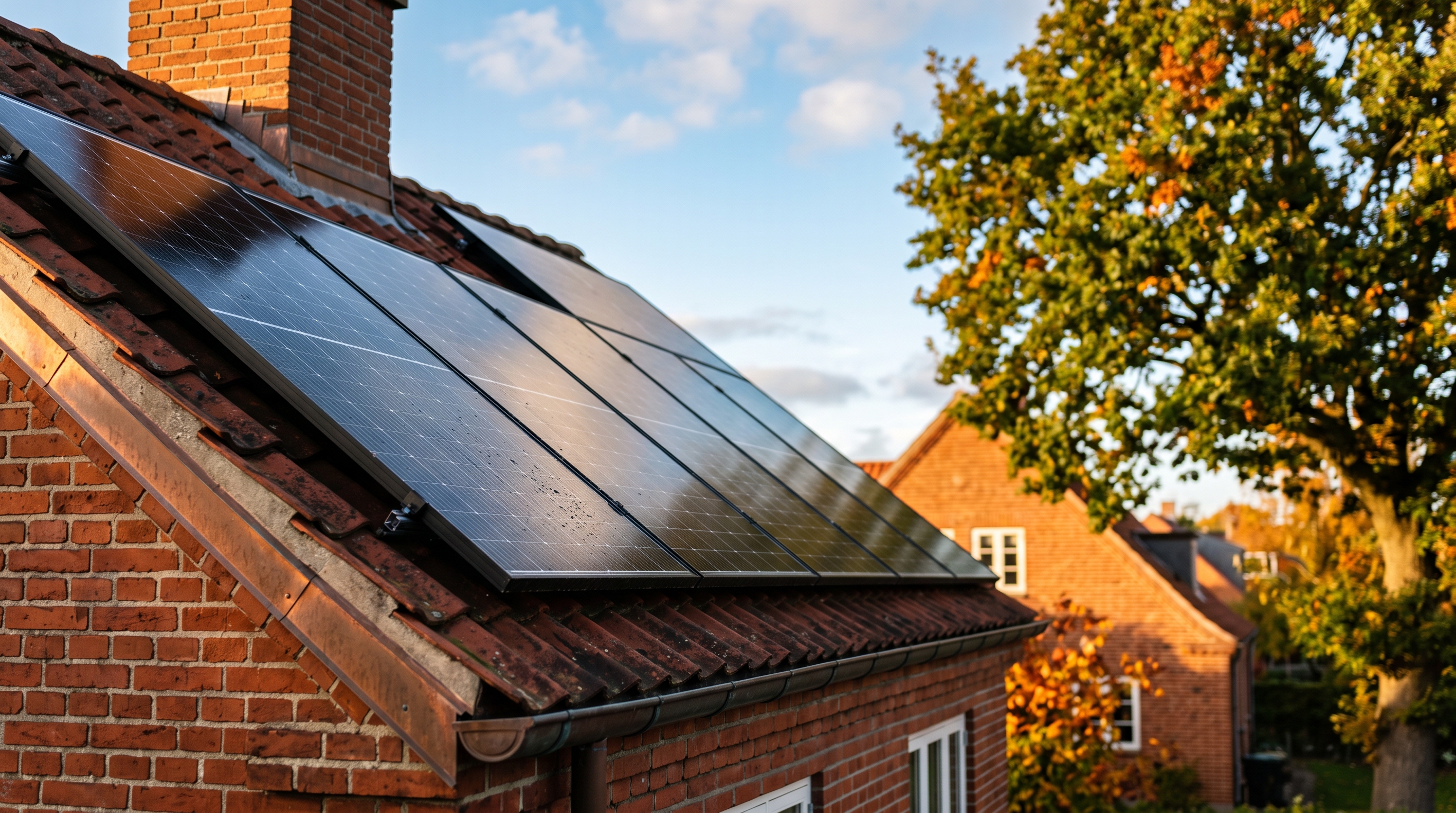
How long do solar panels really last? Degradation, lifespan and what the data says
How long do solar panels really last? Degradation, lifespan and what the data says
When homeowners consider solar panels, the payback period is often the main talking point. But there is another question that is just as important: what happens to the panels after year 10, year 20, year 30? Here we dive into the hard numbers on panel degradation, inverter lifespan, and what you can realistically expect from a modern solar installation.
How much efficiency does a solar panel lose each year?
All solar panels degrade over time. It is unavoidable - UV radiation, temperature swings, humidity, and mechanical stress take their toll on the materials. But the rate depends heavily on the panel type.
N-type panels (2024-2026): The latest N-type panels with TOPCon technology show an average annual degradation of 0.33-0.40 % according to data from Fraunhofer ISE and DNV's independent test programmes. This means a panel after 25 years still delivers approximately 90-92 % of its original output.
P-type panels (older generation): Traditional PERC panels typically degrade at 0.50-0.70 % per year. After 25 years, they deliver around 83-88 % of original output.
The difference between N-type and P-type is roughly 4-7 percentage points after 25 years. On a 10 kWp system, that translates to a difference in annual production of 400-700 kWh in year 25 - equivalent to £80-140 in lost savings per year (at £0.20/kWh).
What does 30-year real-world data tell us?
The oldest solar installations in Europe are now over 35 years old. One of the most cited studies is the LUCY project (Long-term Utility of Crystalline silicon Yield), which measured panels installed in Germany and Switzerland in the 1980s. The results show:
- Annual degradation: 0.30-0.60 % for monocrystalline panels
- After 30 years: 82-91 % of original output
- After 35 years: 79-89 % of original output
- Total failure rate: Below 0.05 % annually (fewer than 1 in 2,000 panels fail completely each year)
What is remarkable is that older 1980s panels - with the technology of that era - perform better than many expected. Modern panels with improved encapsulation, anti-reflective coatings, and purer silicon are expected to degrade even more slowly.
Degradation in UK and Northern European climates: what does the weather mean?
Much of the UK and Northern Europe shares a mild maritime climate that is actually favourable for solar panels. Here are the factors that affect lifespan:
- Temperature: Panels degrade faster in extreme heat. In the UK, summer temperatures are moderate (average 15-25 °C), which reduces thermal stress. The frequent temperature swings between seasons do introduce a different type of cycling stress, however.
- Humidity: High humidity can penetrate panels with poor encapsulation. Modern panels have improved lamination, and the IEC 61215 certification specifically tests for damp heat resistance (85 °C / 85 % relative humidity for 1,000 hours).
- Salt: In coastal areas, salt spray can increase corrosion. IEC 61701 tests for salt mist resistance - choose panels with this certification if you live within a few miles of the coast.
- Wind and snow: Mechanical loading from wind (up to storm force) and snow is tested via IEC 61215. UK and Irish conditions are well within standard design limits.
Overall, the UK and Irish climate is relatively gentle. The primary wear factor is UV radiation over time, not extreme weather events.
Inverter lifespan - the weak link?
While panels last 30+ years, the inverter is the component with the shortest lifespan. Here are the typical figures:
- String inverter: 10-15 years. Most manufacturers offer 5-10 year warranties with options to extend to 15-20 years.
- Microinverters: 20-25 years. Often with 25-year warranties as standard (e.g. Enphase).
- Power optimisers: 20-25 years. Comparable warranties to microinverters.
Over a solar system's 30-year lifespan, you should therefore budget for replacing a string inverter once (around year 12-15). Budget £600-1,200 for a replacement inverter midway through the system's life.
Opting for microinverters avoids this replacement but costs more upfront. For a 4 kWp system (a typical UK residential size), microinverters typically cost £500-1,000 more than an equivalent string inverter setup - but you save the inverter replacement and gain panel-level monitoring as a bonus.
What do manufacturer warranties say - and what do they not cover?
Most panel manufacturers offer two warranties:
| Warranty type | Typical coverage | What it means |
|---|---|---|
| Product warranty | 12-25 years | Covers material defects, delamination, manufacturing faults |
| Performance warranty | 25-30 years | Guarantees minimum output (e.g. 87-90 % after 25 years, 85-87 % after 30 years) |
But here is what warranties typically do not cover:
- Force majeure: Storm damage, lightning strikes, flooding (unless covered by your home insurance)
- Improper installation: If the installer is not MCS-certified (or equivalent local certification)
- Lack of maintenance: If dirt or shading causes hot spots that damage cells
- Cosmetic defects: Minor discolouration that does not affect performance
- Transit damage: Unless discovered and reported before installation
This is where installer choice becomes critical. An MCS-certified installer with a solid track record ensures proper mounting and handling - and that the warranty remains valid.
How does degradation affect the payback period?
Let us put concrete numbers on it. We take a 4 kWp system at £5,500 (a realistic UK price in 2026), with annual degradation of 0.40 % and an average electricity price of £0.28/kWh.
| Year | Output (kWp) | Annual production (kWh) | Annual saving (£) |
|---|---|---|---|
| Year 1 | 4.0 | 3,800 | 1,064 |
| Year 10 | 3.86 | 3,663 | 1,026 |
| Year 20 | 3.70 | 3,510 | 983 |
| Year 30 | 3.55 | 3,361 | 941 |
Total saving over 30 years: Approximately £30,000 (at a constant electricity price - in practice likely more, as prices are expected to rise).
Payback period at £5,500 investment: Roughly 5.5 years.
Even with degradation, the economic case is compelling. After year 30, the system has paid for itself roughly 5-6 times over - and still produces about 88 % of its original output.
On top of that, UK electricity prices have risen by an average of 5-8 % per year over the last decade. If that trend continues - or even moderates - the savings become significantly larger in the second half of the system's life, just when production is marginally lower.
Should you choose panels with 25 or 30-year performance warranties?
Several premium manufacturers now offer 30-year performance warranties instead of the traditional 25 years. Is it worth the extra cost?
For most UK homeowners, the answer is: it depends how long you plan to stay. If you expect to sell within 10-15 years, the 30-year warranty has limited value to you personally - but it can increase the property's sale value, as the buyer gets longer peace of mind.
In price terms, panels with 30-year warranties typically cost 5-10 % more. On a 4 kWp system, that is £275-550 extra. If you stay for 20+ years, the premium is probably recovered through lower degradation - but the difference is marginal.
What we recommend: Prioritise N-type panels with documented low degradation (below 0.40 % annually) over paying extra for the 30-year warranty alone. The two often go hand in hand - N-type panels typically have both longer warranties and lower degradation - but focus on the independent test data rather than the warranty certificate.
Practical tips to extend your solar panels' lifespan
- Choose N-type panels - they have documented lower degradation (0.33-0.40 % annually).
- Ensure proper ventilation - panels with a 10-15 cm air gap behind them stay cooler and degrade more slowly.
- Do not clean panels too aggressively - pressure washers can damage seals and anti-reflective coatings. Ordinary rain handles most of the cleaning.
- Monitor production - modern inverters have apps showing daily output. A sudden drop can indicate a fault.
- Get an inspection after 10-12 years - check seals, cables, and mounting brackets. Catch small issues before they become big problems.
- Check your home insurance - many policies cover storm damage and lightning strikes on solar panels, but not all. Confirm with your insurer.
Conclusion: solar panels last longer than you think
The hard data shows that modern solar panels last at least 30 years with a modest degradation of 0.33-0.40 % per year. After 30 years, an N-type system still delivers roughly 88 % of its original output. The inverter is the only component you need to budget for replacing - and even that can be avoided with microinverters.
In the UK and Irish climate, with moderate temperatures and limited extreme weather, conditions for long panel life are excellent. The primary risk is not technical failure, but improper installation. Choose an MCS-certified installer, choose N-type panels, and your system will produce clean electricity for decades - without any drama.
Sources: Fraunhofer ISE Photovoltaics Report (2025), DNV GL PV Module Reliability Scorecard, LUCY Project (ISE/TUV Rheinland), IEC 61215/61701 standards, manufacturer datasheets for TOPCon N-type panels (Jinko, Longi, Trina), MCS installation standards.