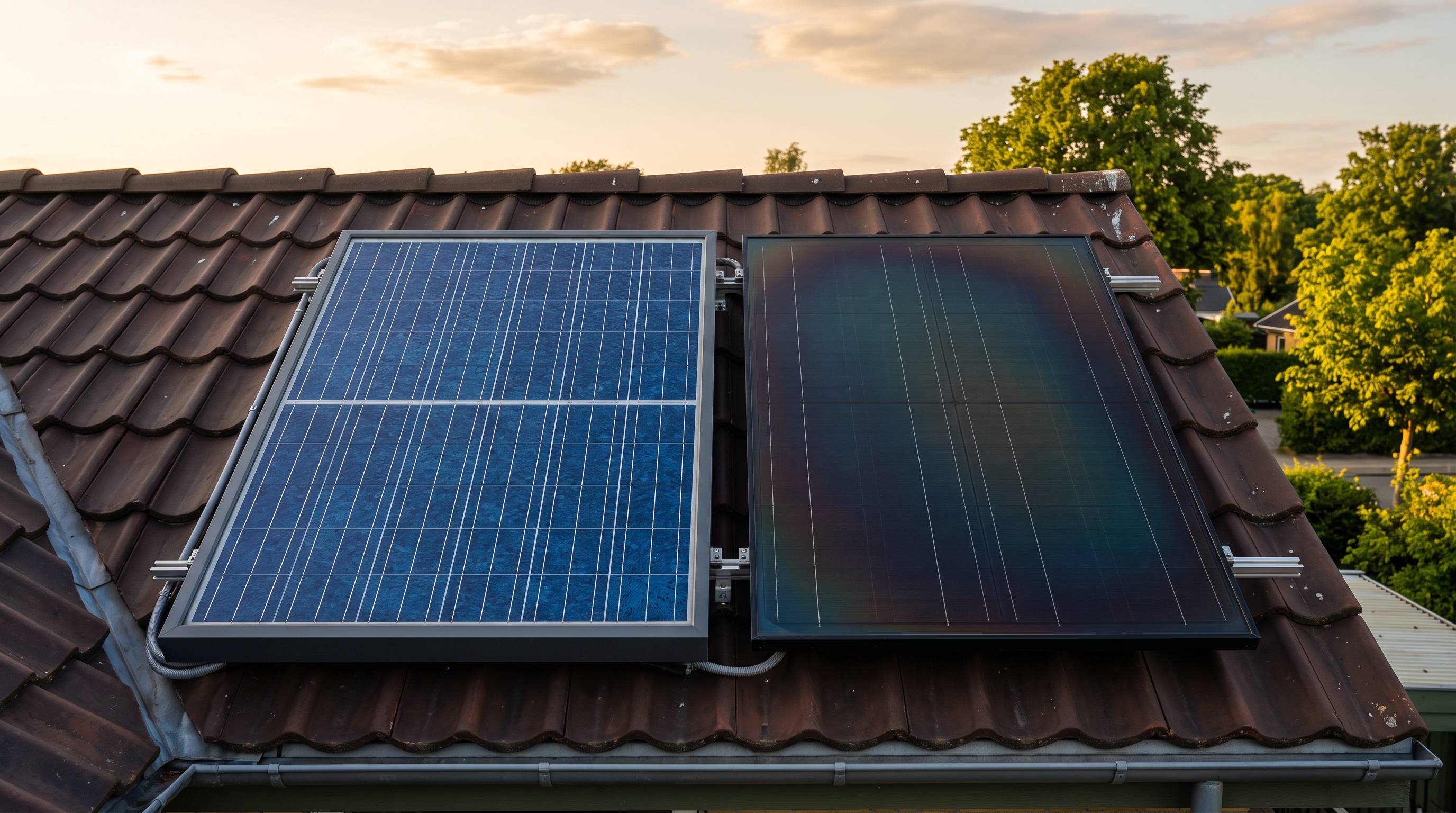
Perovskite vs Silicon Solar Panels: What Do Real-World Tests Show?
Perovskite vs Silicon Solar Panels: What Do Real-World Tests Show?
Perovskite solar cells have long been hyped for their impressive laboratory efficiencies of over 26 %. But when we examine independent field trials from NREL stability data and Germany's Fraunhofer ISE research institute, the picture changes dramatically. Degradation is aggressive under real-world conditions, and no commercial manufacturer currently offers a 25-year warranty on perovskite modules in Europe.
In this article, we break down the actual test results so you can make an informed decision — based on data, not hype.
What Exactly Are Perovskite Solar Cells?
Perovskite refers to a crystal structure that can convert sunlight into electricity with theoretically very high efficiency. The material has attracted enormous attention in the research community because it is cheap to produce and can be applied as thin films on flexible surfaces.
There are three main types of perovskite technology under development:
- Single-junction perovskite: Pure perovskite cell with a lab record of 26.7 % (NREL, October 2024)
- Perovskite-silicon tandem: Combines perovskite and silicon in a single cell — has reached over 33 % in the lab
- Flexible perovskite films: For building-integrated solutions, still at the research stage
However, there is a big difference between what works in a controlled laboratory and what withstands real weather conditions in Northern Europe.
Real-World Efficiency — Not Just the Lab
When solar panels are exposed to rain, frost, UV radiation, and temperature fluctuations, their performance changes significantly. Here is what the independent tests show:
Silicon (PERC/TOPCon):
- 19–22 % efficiency after the first year under Nordic conditions
- Measurements from Risø DTU's test field in Denmark show an average annual degradation of just 0.3–0.5 % over 5 years for PERC panels
- Well-documented performance spanning 25+ years
Perovskite (single-junction):
- Lab record of 26.7 %, but outdoor tests show 15–25 % relative loss after just 1–2 years
- NREL stability data documents significantly faster degradation under humidity and heat
Perovskite-silicon tandem:
- Promising in the lab with up to 33 % efficiency
- No commercial panels with documented 20+ year lifespan available yet
Stability and Degradation — The Deciding Factor
The biggest challenge with perovskite material is stability. It degrades due to:
- Moisture: Even small amounts of water vapour can destroy the perovskite structure
- Heat: High temperatures accelerate chemical breakdown
- UV light: Prolonged UV exposure degrades the material's properties
ISOS test protocols — the international standard for solar cell stability — show that most perovskite cells lose 20–40 % of their output within just 1,000 hours of accelerated testing. That corresponds to just a few years of real-world operation.
By comparison, silicon panels typically lose less than 0.25 % per year — degradation that is 10–20 times slower.
Lifespan and Warranty: What Can You Count On?
For a homeowner in the UK or Ireland considering solar, the warranty is crucial. Here is the current status:
| Parameter | Silicon | Perovskite |
|---|---|---|
| Product warranty | 12–25 years | None commercial |
| Performance warranty | 25–30 years linear (max 0.25 %/year) | Does not exist |
| Documented lifespan | 30+ years | Under development |
| Insurance-approved | Yes | No |
The largest manufacturers — First Solar, Jinko Solar, Trina Solar, and LONGi — have all chosen to invest in silicon or CdTe for their European product range. Perovskite is not yet part of their commercial offerings.
Northern European Conditions Pose Specific Challenges
The climate in the UK, Ireland, and Northern Europe is particularly challenging for perovskite technology. We face:
- High humidity year-round
- Significant temperature swings between summer and winter
- Many hours of low solar irradiation, where every watt counts
- Salt exposure in coastal areas
Under these conditions, silicon panels are thoroughly tested and documented. Perovskite panels have yet to pass the long-term tests required for approval in these markets.
What Does This Mean for You as a Homeowner?
If you are considering solar panels for your home, here is our recommendation based on the available data:
- Choose proven technology: Silicon panels (especially N-type TOPCon) have 25+ years of documented history under Northern European conditions
- Look at the warranty: A 25–30 year performance warranty is standard for quality silicon panels
- Watch the perovskite space: The technology is exciting and may become relevant in 5–10 years once the stability issues are resolved
- Get an independent assessment: EcoRay only recommends solutions with documented performance and manufacturer warranty
Frequently Asked Questions
How far are perovskite solar cells from commercial use in Europe?
Perovskite technology is still primarily in the testing and pilot phase. Leading research institutes estimate it will be at least 5–8 years before perovskite-based panels are competitive on stability and price for the Northern European market.
Can I get perovskite solar panels installed through EcoRay?
No. EcoRay only installs solar solutions with documented performance and manufacturer warranty. Perovskite products are not yet mature enough to be recommended for homeowners in Denmark or Northern Europe.
How much do perovskite solar panels cost compared to silicon?
Perovskite cells are potentially cheaper to manufacture, but since no commercial products with warranty exist on the European market, there is no real price comparison. Silicon panels typically cost £4,000–£8,000 for a standard residential system in the UK.
When will perovskite solar panels be ready for the European market?
Research institutes such as Fraunhofer ISE and DTU Risø estimate that perovskite-silicon tandem panels could reach commercial maturity around 2030–2032. Until then, silicon remains the safe choice for European homeowners.