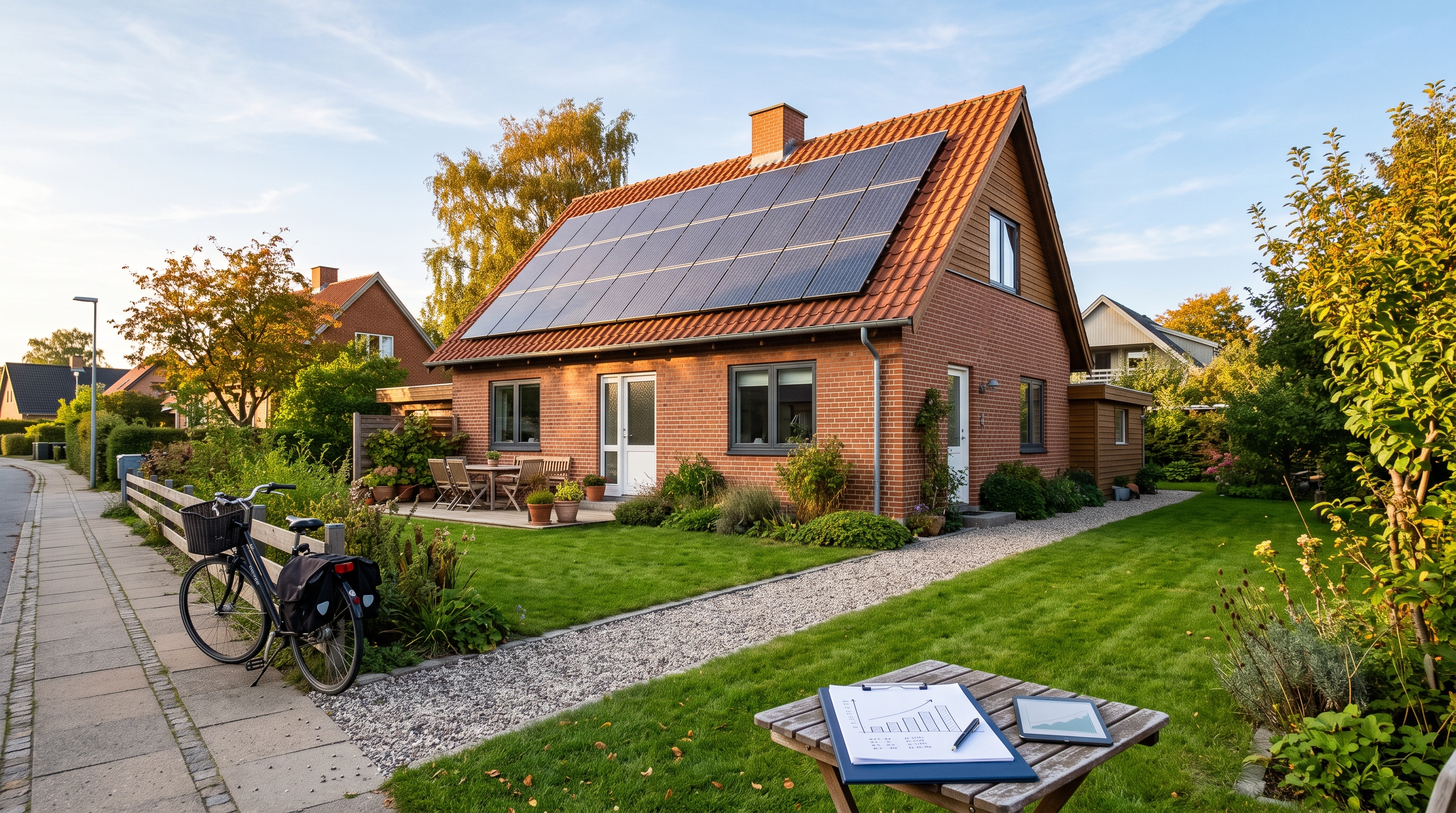
Solar Panel Financing in Denmark: The 5 Best Options for 2026
Solar Panel Financing in Denmark: The 5 Best Options for 2026
One of the first questions Danish homeowners ask when considering solar panels is: "How do I pay for it?" It is a good question. A solar panel system typically costs between 65,000 and 140,000 kroner (approximately £7,500 to £16,000) — and the right financing option can save you tens of thousands over the system's lifetime.
Quick overview of the 5 options:
| Financing Method | Monthly Cost (approx.)* | You Own the System? | Best For |
|---|---|---|---|
| Cash Payment | 0 kr. (one-off) | Yes | Those with savings |
| Green Home Loan | 800-1,200 kr. | Yes | Homeowners with equity |
| Energy Financing (Resurs) | 900-1,400 kr. | Yes | Quick application |
| Solar Leasing | 500-900 kr. | No (leasing company) | Those without savings |
| Solar Subscription | 400-800 kr. | No (provider) | Tenants and co-op owners |
*Based on a 100,000 kr. system over 10-12 years. Actual figures depend on your consumption, roof, and credit assessment.
1. Cash Payment: No Interest, Full Control
Paying cash is the simplest solution. You pay the full amount upfront and own the system from day one.
Advantages:
- No interest or fees
- You keep the full savings from day one
- Complete ownership — you control everything
- Highest total savings over the system's lifetime
Disadvantages:
- Requires significant savings (65,000-140,000 kr.)
- Ties up liquidity that could be used elsewhere
Who is it best for? Homeowners with solid savings who want the best long-term return. If you have money sitting in a savings account earning 0.5% interest, solar panels deliver a significantly better return — often 8-12% annually when factoring in electricity savings.
2. Green Home Loan: Low Interest via Your Bank
Several Danish banks offer special "green loans" with lower interest rates for energy improvements — including solar panels. Interest rates typically range from 2.5% to 4.5% in 2026.
Advantages:
- Lower interest than personal loans
- You own the system yourself
- Interest may be tax-deductible (depending on loan type)
- Often possible with up to 2 years of payment deferral
Disadvantages:
- Requires home equity — or other collateral
- Bank must approve the application (income, debt ratio)
- Longer processing time (1-3 weeks)
Who is it best for? Homeowners with equity and stable income who want low interest rates and full ownership. Nordea, Danske Bank, and Arbejdernes Landsbank all offer green loan products in 2026.
Example: A green loan of 100,000 kr. over 10 years at 3.5% gives a monthly payment of approximately 990 kr. Total interest cost over the period is around 18,800 kr.
3. Energy Financing via Resurs Bank: Fast and Simple
Resurs Bank (formerly yA Bank) is the most widely used specialist in energy financing in Denmark. They offer loans specifically for solar panels, heat pumps, and energy renovation — often through your solar installer.
Advantages:
- Fast application — often same-day answer
- No requirement for home equity (security is in the system itself)
- Term of 2-15 years, you choose
- Direct collaboration with the installer — less administration
Disadvantages:
- Higher interest than green home loans (typically 4-8%)
- Credit check required
- Fixed monthly payment regardless of electricity prices
Who is it best for? Homeowners without home equity or those wanting a quick process outside the bank. Also well-suited for younger homeowners without large savings.
Example: A Resurs loan of 100,000 kr. over 10 years at 6% gives a monthly payment of approximately 1,110 kr.
4. Solar Leasing: Start Saving Immediately
With leasing, you pay a fixed monthly fee to use the system while the leasing company owns it. After the leasing period (typically 15-20 years), you can often buy the system at a reduced price — or get a new one.
Advantages:
- No upfront payment
- Fixed monthly fee — predictable finances
- Service and maintenance included
- You save on your electricity bill from day one
Disadvantages:
- You do not own the system (unless you buy it after the leasing period)
- Higher total cost over time than cash or loan
- Leasing agreements can be difficult to exit
- Limited flexibility — you cannot always choose panels and inverter yourself
Who is it best for? Homeowners who want to get started immediately without tying up savings or borrowing. Works well for pensioners and families on a tight budget.
5. Solar Subscription: For Those Who Cannot or Will Not Own
A solar subscription works like a mobile phone contract: you pay a fixed, low monthly price for the electricity from the system that the provider installs on your roof. You typically commit for 20-30 years.
Advantages:
- No upfront payment, no debt, no worries
- Electricity at a fixed, low price — independent of electricity price fluctuations
- Service, monitoring, and repairs included
- Can be terminated upon change of ownership (depends on the agreement)
Disadvantages:
- You own neither the system nor the electricity
- Long commitment period (20-30 years)
- Limited availability in Denmark (fewer providers than leasing)
- Not available for all house types
Who is it best for? Tenants, co-op owners, and homeowners who absolutely do not want to own or borrow. Also relevant for homeowners with low credit scores.
Total Cost Comparison Over 15 Years
Here is a calculation example for a 100,000 kr. system. Actual figures depend on your situation:
| Financing Method | Total Payment over 15 Years | Own After 15 Years? |
|---|---|---|
| Cash | 100,000 kr. | Yes |
| Green Home Loan (3.5%) | 118,800 kr. | Yes |
| Resurs Financing (6%) | 133,200 kr. | Yes |
| Leasing (900 kr./month) | 162,000 kr. | No (unless bought out) |
| Subscription (600 kr./month) | 108,000 kr. | No |
Important: The table only shows the cost side. The electricity savings are the same regardless of financing method — typically 7,000-12,000 kr. per year for a standard system. So even with leasing or a loan, you are still in the black each month.
How to Choose the Right Financing
Here is a simple decision guide:
- Do you have savings? → Cash gives the best return
- Do you have home equity? → A green home loan gives low interest
- Want to get started quickly? → Resurs financing through your installer
- Want to avoid a loan? → Leasing or subscription
- Are you a pensioner? → Leasing provides security with a fixed fee and included service
- Are you a tenant or co-op owner? → Subscription is often the only option
Remember Grants and Tax Deductions
Regardless of which financing method you choose, in 2026 you can still receive:
- Craftsman's Deduction (BoligJobordningen): Tax deduction for labour costs of up to approximately 8,600 kr. per person in the household. For a couple, that is up to approximately 17,200 kr. in total deduction.
- Reduced Electricity Tax: You only pay partial electricity tax on the electricity you produce and consume yourself — a saving of approximately 70 ore per kWh.
- Municipal Grants: Several municipalities offer special grants for energy renovation — check your municipality's website.
Frequently Asked Questions
What is the cheapest way to finance solar panels?
Cash payment is cheapest over time, as you avoid interest. A green home loan with low interest is second best. Leasing and subscriptions have higher total costs but require no savings.
Can I get solar panels with no upfront payment?
Yes. Both leasing, subscriptions, and certain energy financing options offer 0 kr. upfront. You instead pay a fixed monthly fee. Note that the total price over time will be higher than cash payment.
How long does a financing application take?
Resurs financing often provides an answer the same day. A green home loan through a bank typically takes 1-3 weeks. Cash payment is, of course, immediate.
What happens to the financing if I sell my house?
For loans (bank or Resurs), you can either pay off the loan upon sale or transfer it to the buyer. For leasing and subscriptions, the agreement must either be taken over by the buyer or terminated — check the terms in your contract.
Are solar panels a good investment when you need to borrow?
Yes, for most homeowners. Even with a 100,000 kr. loan at 6% interest, the monthly payment is approximately 1,110 kr., while the average electricity saving is 600-1,000 kr. per month. Once the loan is paid off after 10-12 years, you have free electricity for the remainder of the system's lifetime (15-25 more years).