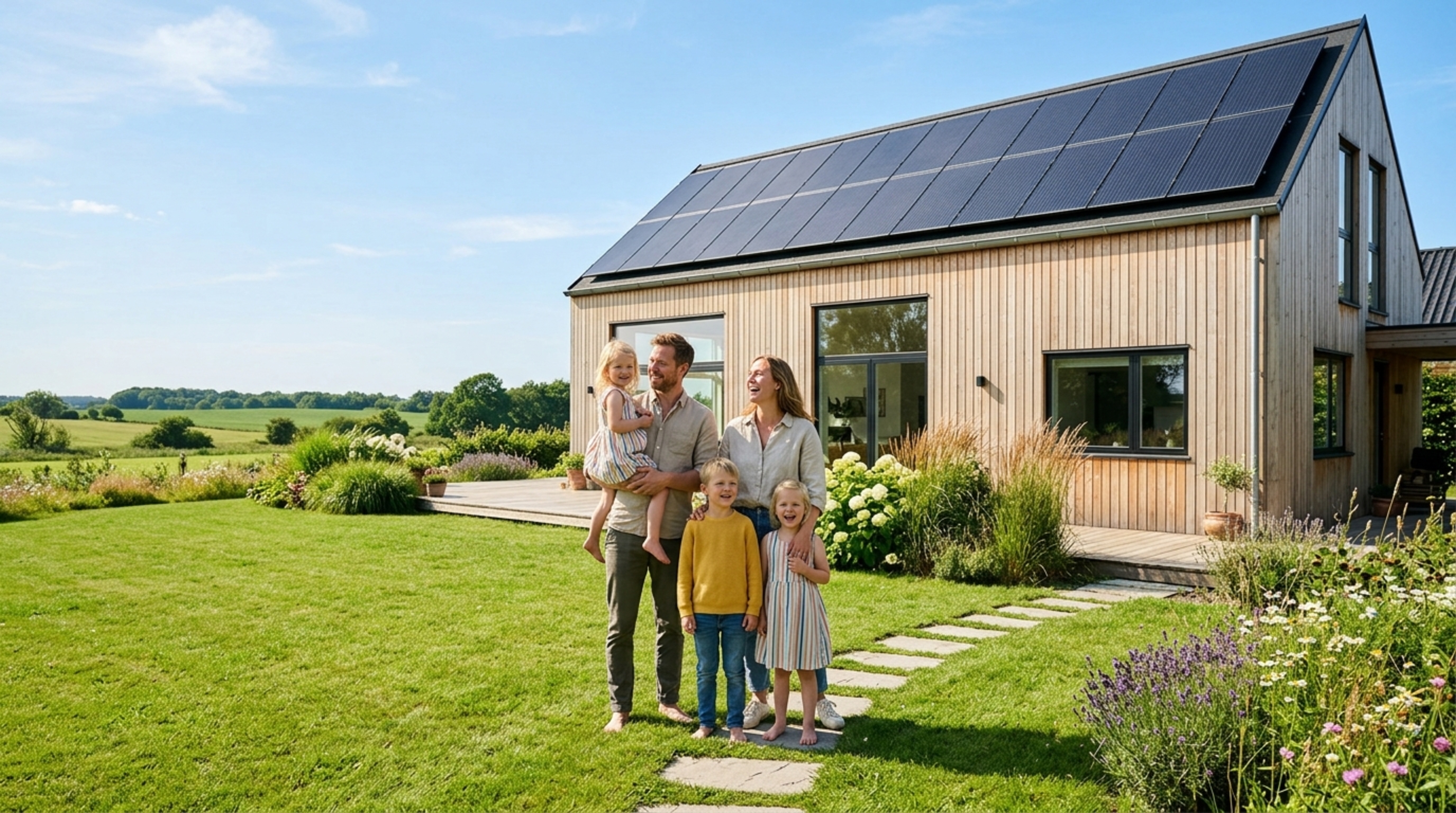
How Your Family Can Save CO₂ and Money with Solar Panels: See the 2026 Numbers
How Your Family Can Save CO₂ and Money with Solar Panels: See the 2026 Numbers
As a parent, you probably think about the world your children are growing up in. But did you know that rooftop solar panels aren't just good for your wallet. They're actually one of the most concrete climate actions a family can take?
In this article, we break down the real CO₂ savings figures, how to get the most out of your system, and what the overall climate impact means for your family's future.
How Much CO₂ Do Solar Panels Actually Save?
The short answer: A typical family saves around 1.2 tonnes of CO₂ per year by installing a 6 kWp solar panel system.
That might sound abstract. So let's put it in perspective:
- 1.2 tonnes of CO₂ equals driving 7,500 km in a petrol car. That's London to southern Italy and back
- It equals 6 return flights from London to Rome
- It equals what 60 newly planted trees absorb in one year
And the best part? The savings continue year after year. Over a 30-year system lifetime, that's 36 tonnes of CO₂. That's equivalent to taking 8 petrol cars permanently off the road.
The Calculation: How We Got to These Numbers
The figures are based on the UK government's latest grid carbon intensity data for 2026. Here's the detailed breakdown for a typical family in a 3-bedroom semi-detached house:
| Parameter | Value |
|---|---|
| System size | 6 kWp (approx. 15 panels) |
| Annual generation | 5,700 kWh |
| Self-consumption (with battery) | 70% |
| Grid export | 30% |
| Grid carbon intensity (UK average) | 0.21 kg CO₂/kWh |
| Annual CO₂ savings | 1,197 kg ≈ 1.2 tonnes |
Note that the savings are even greater if you have a battery to increase self-consumption. More on that below.
CO₂ Savings by Home Type
Not all families live in detached houses. Here are the expected figures for different home types:
Detached House (4+ bedrooms, 6 kWp system)
- Annual generation: 5,700 kWh
- Annual CO₂ savings: 1.2 tonnes
- Equivalent to: 7,500 km driven
Semi-Detached / Terrace (3 bedrooms, 4 kWp system)
- Annual generation: 3,800 kWh
- Annual CO₂ savings: 0.8 tonnes
- Equivalent to: 5,000 km driven
Larger Detached (5+ bedrooms, 8 kWp system)
- Annual generation: 7,600 kWh
- Annual CO₂ savings: 1.6 tonnes
- Equivalent to: 10,000 km driven
Flat / Apartment (share of communal system, 2 kWp)
- Annual generation: 1,900 kWh
- Annual CO₂ savings: 0.4 tonnes
- Equivalent to: 2,500 km driven
The Battery Makes the Difference for Both Climate and Finances
Many families ask: "Is a battery worth the money?" The answer depends on your priorities.
Without a battery, self-consumption typically sits at 30-40%. The rest of your solar power goes to the grid at a low export rate, while you buy expensive electricity back in the evening.
With a 10 kWh battery, self-consumption rises to 70-80%. That means:
- Extra CO₂ savings: approx. 300 kg/year (because you displace more fossil backup power)
- Extra financial savings: £250-£400/year (depending on electricity prices and your tariff)
- Increased self-sufficiency: Up to 80% of your family's electricity comes from your own panels
For a family running washing machines, cooking dinner, and charging devices in the evening, a battery makes excellent sense.
5 Practical Tips to Maximise Your Family's Climate Impact
1. Get a Battery, Even if It Costs Extra Now
A battery investment pays for itself in 8-12 years at current electricity prices. But the climate benefit starts from day one. Your children grow up in a home genuinely powered by solar, not just when the sun shines.
2. Shift Your Electricity Use to Daytime Hours
Washing machine, dishwasher, and tumble dryer can all be set on timers to run between 10am and 4pm when production is highest. Most modern appliances have built-in delay timers. It's the easiest way to boost self-consumption without any additional investment.
3. Switch to an Electric Vehicle: The Perfect Solar Partner
An EV charged at home with solar power nearly doubles your family's CO₂ savings. With a 6 kWp system and an EV, a family can save over 2 tonnes of CO₂ per year, while also saving £800-£1,200 on fuel costs.
4. Monitor Your Usage and Make It a Family Activity
Many solar panel owners are surprised by how fun it is to track production. Make it a game with the kids: "How many kWh did we generate today? How much CO₂ did we save?" Apps like Loop and Octopus Energy's dashboard make it easy and engaging.
5. Think Long-Term: Solar Panels Last 30+ Years
A solar panel system is an investment that extends well beyond your own time in the house. By the time your children inherit the home, the system will have already saved 36 tonnes of CO₂. That's a lasting climate contribution.
What About the Carbon Footprint of Manufacturing the Panels?
It's a fair question, and many parents ask it. Here are the numbers:
- Manufacturing a 6 kWp system emits approximately 3-4 tonnes of CO₂ (including panels, inverter, mounting, and transport)
- With annual savings of 1.2 tonnes, the system becomes carbon-neutral after 3-4 years
- The remaining 30+ years of lifetime are pure climate gain
In other words: After about 3.5 years, your solar panels have "repaid" their carbon debt. Everything after that is a gift to your children's future.
The Financials: What Does It Mean for Your Family Budget?
Let's look at the numbers for a family in a 3-bedroom semi-detached with an annual electricity consumption of 4,500 kWh:
| Item | Without Solar | With Solar + Battery |
|---|---|---|
| Annual electricity bill | £1,350 | £400 |
| Self-generated power | 0 kWh | 3,990 kWh |
| Grid purchases | 4,500 kWh | 510 kWh |
| Annual savings | £0 | £950 |
| CO₂ emissions (electricity) | 1,050 kg | 212 kg |
Total annual benefit: £950 saved + 838 kg CO₂ reduced.
With an investment of roughly £8,000-£10,000 for panels + battery, the payback period is 8-11 years, and after that you have free electricity for another 15-20 years.
Make Your Home Part of the Solution
As a parent, there are few things that feel better than knowing you're doing something concrete for your children's future. Solar panels are no longer just for eco-warriors or tech enthusiasts. They're for ordinary families who want to save money and look after the planet at the same time.
And in 2026, it's easier than ever: Prices have fallen, the technology has matured, and advice has become far more transparent.
Frequently Asked Questions
How long until solar panels become carbon-neutral?
For a standard 6 kWp system, it takes approximately 3-4 years to offset the CO₂ emitted during manufacturing. The remaining 30+ years of the system's lifetime are pure carbon savings.
Can we still save CO₂ in winter when the sun shines less?
Yes. Solar panels still generate electricity in winter, typically 10-20% of summer output in UK conditions. Over a full year, the clean solar power still displaces significant fossil fuel generation from the grid.
What happens to the solar panels when we eventually sell the house?
A home with solar panels is worth more. Estate agents increasingly report that solar panels add 3-5% to a property's value, as buyers inherit a home with low running costs and green credentials.
Are there grants for solar panels in 2026?
In the UK, the ECO4 scheme and the Smart Export Guarantee (SEG) provide ongoing support for solar installations. Several local councils also offer green home improvement grants. The 0% VAT rate on solar panels and batteries remains in place. Contact us for an overview of what applies in your area.
Want to know how much CO₂ and money your specific family can save? Book a no-obligation assessment based on your actual home and usage. Our advisors tell it straight, including what might not be worth your while.