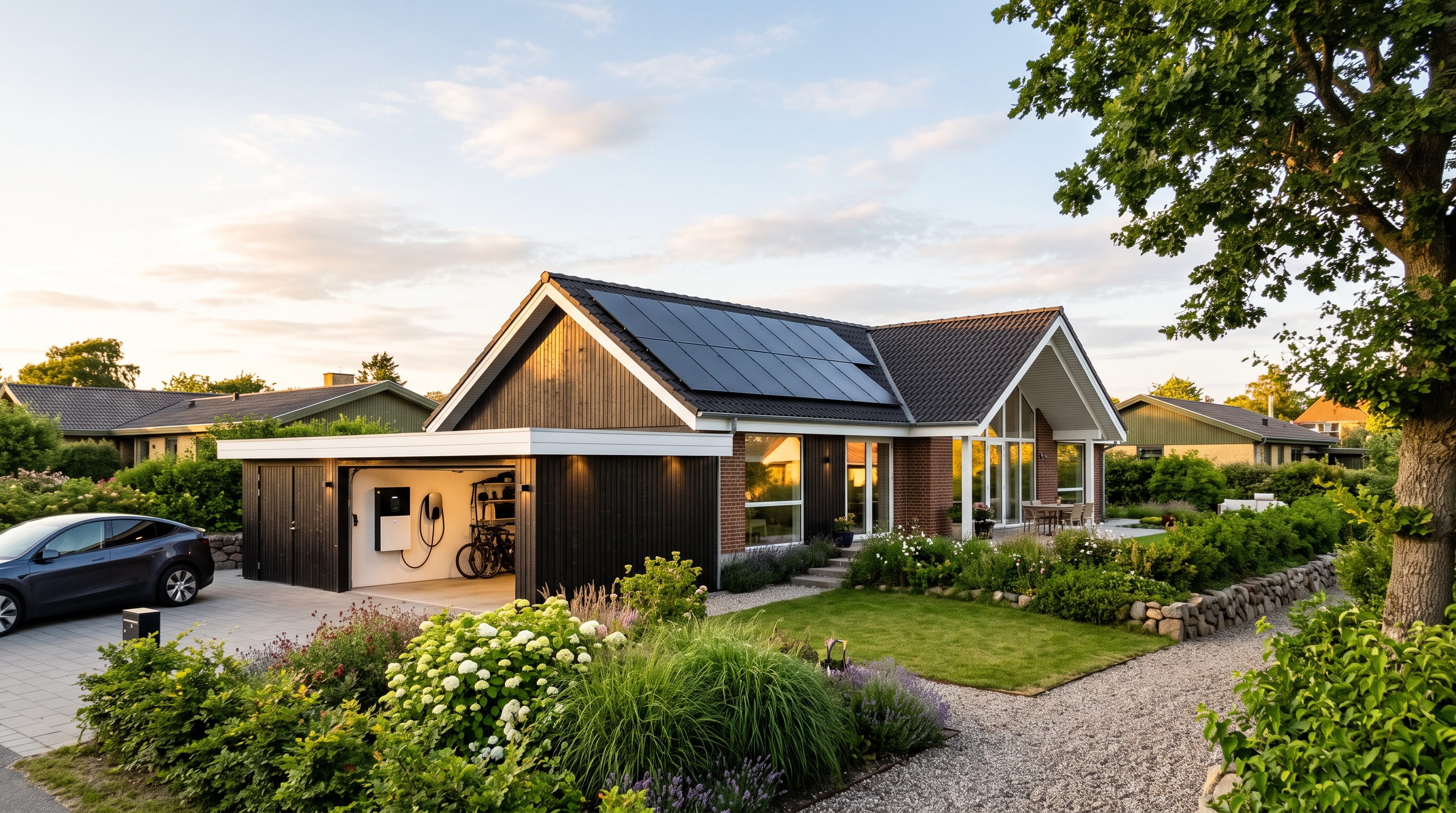
Solar Panels with Battery Storage in 2026: Costs, Technology & What to Expect
Solar Panels with Battery Storage in 2026: Costs, Technology & What to Expect
Interest in home battery storage has surged in recent years — and for good reason. While solar panels alone typically give you about 30% self-sufficiency, adding a battery can push that to 65–75%. That means fewer expensive kilowatt-hours from the grid and more control over your energy bills.
But what does a battery actually cost? How long does it take to pay for itself? And which technology should you choose? Here's an honest overview of the economics of home battery storage in 2026.
What Does a Home Battery Cost in 2026?
Battery prices have fallen significantly over the past five years. In 2026, a complete 10 kWh battery system typically costs between £3,500 and £5,500 (€4,000–€6,500) including installation and VAT. The price difference depends on:
- Battery chemistry: LFP (lithium iron phosphate) is now the standard, costing around £350–£500 per kWh installed
- Inverter compatibility: Is your existing inverter hybrid-ready, or does it need replacing?
- Installation complexity: Easy access to your consumer unit and placement in a utility room or garage
Most UK and European households choose an 8–12 kWh battery, as it fits a typical annual consumption of 3,500–4,500 kWh with a 5–7 kWp solar array.
Price Example: 10 kWh Battery for a Detached Home
| Item | Price (approx.) |
|---|---|
| Battery module 10 kWh LFP | £2,500–£3,500 |
| Installation and connection | £800–£1,200 |
| Potential inverter upgrade | £0–£1,000 |
| Total | £3,300–£5,700 |
How Much Can You Save on Your Electricity Bill?
The actual figure depends on your consumption patterns, electricity prices, and battery size. Here's a worked example for a typical UK household:
- Annual consumption: 3,800 kWh
- Solar array: 5 kWp (annual output ~4,500 kWh)
- Without battery: Self-sufficiency ~30% → buying 2,660 kWh from the grid
- With 10 kWh battery: Self-sufficiency ~70% → buying 1,140 kWh from the grid
- Annual saving: 1,520 kWh × £0.28/kWh = £426 per year
With an investment of roughly £4,500, that gives a simple payback period of 8–12 years. It might sound long, but:
- An LFP battery lasts 10–15 years — longer than the payback period
- Energy prices are expected to rise over time, shortening the payback
- Solar+battery increases your home's value — UK estate agents report solar panels can add 4–5% to property values on average
Note for UK readers: Unlike Denmark, the UK does not currently have widespread time-of-use export tariffs that reward evening discharge. However, Octopus Energy and others are rolling out smart export guarantees and time-of-use tariffs that significantly improve the battery business case.
LFP vs. NMC: Which Battery Chemistry Should You Choose?
There are two dominant battery technologies for home use:
LFP (Lithium Iron Phosphate) — Recommended
- Lifespan: 6,000–8,000 cycles (10–15 years)
- Safety: High — very stable chemistry, no risk of thermal runaway
- Price: £350–£500/kWh installed
- Downside: Slightly lower energy density (larger and heavier)
NMC (Nickel Manganese Cobalt)
- Lifespan: 4,000–6,000 cycles (8–12 years)
- Safety: Moderate — higher risk of overheating
- Price: £300–£450/kWh installed
- Upside: Higher energy density (smaller and lighter)
Conclusion: LFP is the clear choice for home batteries in 2026. Safety is significantly better, lifespan is longer, and the price difference is minimal. Nearly all new residential installations across Europe use LFP.
Who Should Consider a Battery — And Who Should Wait?
A battery makes the most sense if you:
- Have high evening electricity consumption when the sun isn't shining
- Are on a time-of-use tariff (like Octopus Agile or Economy 7) and can charge when electricity is cheap
- Want backup power during outages (not all batteries support this — check the specifications)
- Aim to maximise your energy independence and reduce grid reliance
You might want to wait if you:
- Have low electricity consumption (under 2,500 kWh/year) — the savings will be proportionally smaller
- Live in a flat or rented property where installation is complicated
- Plan to move within 3–5 years — you won't recoup the investment
- Don't have solar panels yet — start with the panels, a battery can always be added later
Solar + Battery: Start With the Panels
The most important thing is to get generation sorted first. Solar panels alone typically have a payback period of 5–8 years — significantly shorter than the battery. Once the panels are installed, you can monitor your actual consumption patterns for 6–12 months and then assess whether a battery makes sense for your situation.
Many of our Danish customers start with solar panels alone and add a battery after 1–2 years once they have real consumption data. It's the approach that gives you the best decision-making foundation.
The Future of Home Battery Storage
Battery technology is advancing rapidly. Here are three trends shaping the market in the coming years:
- Continued price drops: IRENA expects battery prices to fall a further 20–30% by 2030
- Vehicle-to-Grid (V2G): Your electric car becomes a massive battery on wheels — multiple manufacturers are launching bidirectional charging in 2026–2027. The UK is particularly advanced on V2G regulatory frameworks
- Smart energy management: Modern HEMS (Home Energy Management Systems) automatically optimise when your battery charges and discharges based on electricity prices, weather forecasts, and your consumption patterns
Frequently Asked Questions
Are there grants for home battery storage in 2026?
In the UK, standalone battery storage does not currently qualify for direct government grants. However, batteries installed as part of a solar PV system may be eligible for 0% VAT (under the UK's energy-saving materials relief, extended through 2027). Some local authorities and energy companies offer additional incentives. In the EU, several countries offer low-interest green loans for solar+battery installations. Always check current schemes with your installer or energy provider.
How long does a home battery last?
A quality LFP battery typically lasts 10–15 years before capacity drops to about 70% of the original. With 6,000–8,000 cycles, that's equivalent to one full charge and discharge every day for 16–22 years. Most manufacturers offer a 10-year product warranty.
Can the battery provide power during a blackout?
Some battery systems have a backup function (often called EPS — Emergency Power Supply), but this is not standard. If backup power matters to you, specifically choose a system that supports islanding (off-grid operation). Ask your installer before purchasing.
What happens to the battery in winter?
During the winter months, solar panels produce less, and the battery is less frequently fully charged. This means the financial benefit is smaller from November to February. But in spring, summer, and autumn — roughly 8 months of the year — the battery works at full capacity.
Conclusion
A home battery isn't a "get rich quick" investment — but it's a solid, long-term improvement to your home's energy system. With a payback period of 8–12 years and an expected lifespan of 10–15 years, it makes financial sense for most homeowners with typical electricity consumption.
The best advice: Start with solar panels, get to know your consumption patterns, and add a battery when the numbers speak for themselves.
Want a tailored quote for solar panels with battery storage? Try our calculator or get in touch for a no-obligation chat.
Sources: IRENA Battery Storage Report 2025, UK Department for Energy Security & Net Zero 2025–2026, Solar Energy UK market data, Octopus Energy tariff analysis 2026.